VI5 - Vector | Ion Exchange 5
VI5 - Vector | Ion Exchange 5
VI5 — Vector
Ion Exchange
Micronised filter powder · water quality control · remineraliser
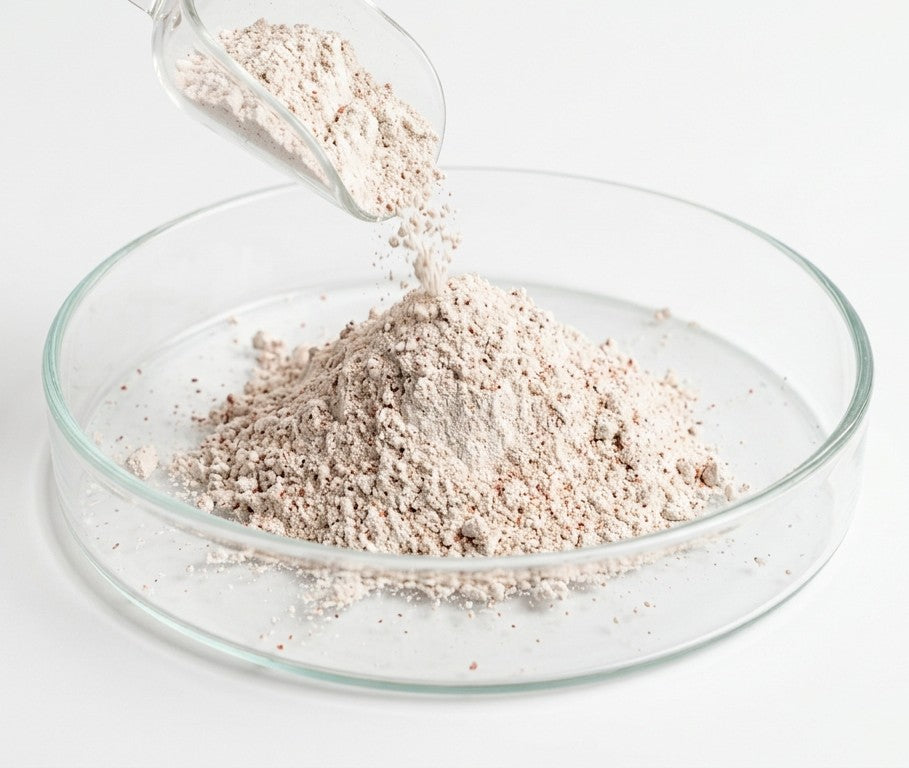
A mineral-dense mixture of different clays and aluminosilicate-based molecular sieves — primarily a micronised filter powder and water quality control powder that remineralises as it works. Use it by itself to filter the water while adding back the good things, or mix it with other products to act as a delivery vector for them.
Used by itself it filters the water whilst adding back the good things — capturing dissolved heavy metals and contaminants through absorbing and ion exchange while releasing calcium Ca²⁺, magnesium Mg²⁺, potassium K⁺ and sodium Na⁺ back into solution. Mixed with other products it acts as a delivery vector for them: amino acids and foods for corals, or probiotics for all aquatic applications — brew your bacteria with VI⁵ so they grow on the outside of the particles, then dose that into the water.
VI⁵ Dose Rate
Use VI⁵ for direct water treatment or as a mineral transport vector for probiotic and beneficial microbial applications.
1 g / 25 L
One gram of VI⁵ per 25 litres of system waterFlexible application: More or less can be used according to your preferences and the requirements of your system.
✓ Direct water treatment — dose VI⁵ directly into the water column.
✓ Probiotic application — use VI⁵ as a mineral transport and colonisation surface for beneficial microbes.
When using VI⁵ as a probiotic vector, it can be mixed with the microbial product before application so the microbes have an opportunity to contact the mineral surface first.
Why Professionals Choose VI⁵
Most water treatments do one job. VI⁵ does five — and it was engineered around the first one: delivering beneficial microbes where they need to be.
The Vector Advantage
Dosed microbes need somewhere to live. Free-floating cells face dilution, predation and washout. Every VI⁵ particle is a microscopic colonisation surface — microbes attach within minutes, form protected biofilms, and establish from a stable mineral base.
Molecular Sieve Architecture
Precision pore networks at molecular scale. The aluminosilicate sieve fraction captures dissolved organics — tannins, phenolics, odour molecules — within structured pore channels, not just on flat surfaces.
Exchange While It Works
One dose, two directions. Charged mineral surfaces swap their cations with dissolved species: heavy metals are captured while calcium Ca²⁺, magnesium Mg²⁺, potassium K⁺ and sodium Na⁺ are released. Detoxification and remineralisation in the same motion.
The Five Modes of Action
The 5 in VI⁵ is not decoration — it is the count of independent mineral sciences working in every dose.
1 · Transport Vector
Delivery vehicle for beneficial microbes. Every particle is a microscopic colonisation surface. Dosed microbes attach within minutes, form protected biofilms and continuously seed the water column from a stable mineral base.
2 · Absorbing
Molecular sieve capture. Aluminosilicate pore networks trap dissolved organics — tannins, phenolics, odour molecules — while iron-bearing surfaces bind dissolved phosphate into stable precipitates.
3 · Ion Exchange
Cations swap at charged surfaces. Heavy metals are captured — lead Pb, cadmium Cd, copper Cu, zinc Zn, nickel Ni, chromium Cr, cobalt Co and manganese Mn — while calcium Ca²⁺, magnesium Mg²⁺, potassium K⁺ and sodium Na⁺ are released in trade. Detoxify and remineralise in one motion.
4 · Flocculator & Clarifier
Grabs charged particles and sinks them. Charged particles neutralise colloidal suspension charges so silt fines, organics and cloudiness agglomerate into dense flocs that sink to the bottom — where they can be pulled out by mechanical filtration or gravel syphons. If ever stirred up again, they are re-captured the same way. Settled flocs are then organically remineralised by probiotic bacteria for plants.
5 · Remineralising
Beneficial minerals released. As ions exchange off mineral surfaces, VI⁵ releases calcium Ca²⁺ for buffering and osmoregulation, magnesium Mg²⁺ as enzyme cofactor, potassium K⁺ for electrolyte balance, sodium Na⁺ for osmotic support and trace iron Fe — mirroring the ion exchange trade in reverse.
Powerful By Itself. Vector for Anything.
The probiotic transport vector was the main design idea behind VI⁵ — but the other benefits it brings are just as if not more powerful. Use it as a vector for anything, or just to polish the water.
Micronised Density
Particle engineering matters. Milled to a 150–200 micron powder that is micronised even finer, maximising reactive surface area per gram — more exchange sites, more adsorption capacity and more colonisation surface in every dose than coarse mineral products.
Skim Resistant
Stays in the system. VI⁵ helps prevent removal by protein skimming or mechanical filtration — it sticks around, sinking into the substrate where it keeps working instead of being exported straight out.
Washout Proof
Survives water changes. Particles settle into the substrate and seed those surface areas with higher specific gravity — pre-colonised zones that persist through water exchange, boosting application effectiveness every time.
Predation Protection
A safe start for microbes. Particles give dosed microbes an area to pre-colonise before entering the water column — preventing predation straight up and giving cultures a stable mineral base to establish from.
Plant Health Support
Grows plants as it treats water. Released potassium and magnesium are macronutrients for aquatic plants — plus terrestrial plants in aquaponic systems.
Substrate Enhancement
Feeds the bed. Settled particles enhance the biological activity and nutrient density of substrates — colonised grains become slow-release mineral banks for rooted plants and probiotic bacteria alike.
What VI⁵ Removes
Every target below is captured by one of the five modes of action — ion exchange, molecular sieve adsorption, iron-mediated precipitation or flocculation.
| Target Class | Examples | Primary Mechanism |
|---|---|---|
| Heavy Metals | Lead Pb · Cadmium Cd · Copper Cu · Zinc Zn · Nickel Ni · Chromium Cr · Cobalt Co · Manganese Mn | Ion exchange + surface complexation |
| Phosphate | Dissolved orthophosphate PO₄³⁻ | Iron-mediated precipitation |
| Dissolved Organics | Tannins phenolics odour molecules | Molecular sieve adsorption |
| Colloidal Turbidity | Silt clay fines suspended solids | Charge neutralization + flocculation |
| Planktonic Algae | Green-water single cells | Flocculation and settling |
| Bacterial Bloom Cloudiness | Heterotrophic blooms | Flocculation + organics removal |
| General Environmental Contaminants | Air pollution runoff residues | Adsorption |
| Ammonium | NH₄⁺ | Ion exchange (support role) |
Flocculation acts on suspended cells and particles. Filamentous or matted algae is addressed indirectly through long-term phosphate binding.
What VI⁵ Adds
Ion exchange is a two-way trade. As contaminants are captured, beneficial minerals are released back into solution.
| Addition | Function in the Water Column |
|---|---|
| Colonisation Surface | Biofilm substrate for colonisation by beneficial microbes — 150+ m² per gram of powder providing a huge amount of filtration as it contacts the water |
| Calcium Ca²⁺ | Buffering and osmoregulation support |
| Magnesium Mg²⁺ | Enzyme cofactor |
| Potassium K⁺ | Electrolyte balance |
| Sodium Na⁺ | Osmotic support |
| Trace Iron Fe | Micro-dose remineralisation |
| Trace Minerals | Trace levels of other minerals such as nickel Ni, cobalt Co, silica Si, manganese Mn, fluorine F, tin Sn, lithium Li and titanium Ti |
Not just pulling contaminants out. Not just putting minerals in. Both at once — by design.
Built for Two Programs
VI⁵ earns its place in both the microbial program and the filtration program — same product, same five sciences.
In the Microbial Program
The carrier that makes every dose stick. Brew or co-dose VI⁵ with any beneficial microbe blend and every litre becomes charged with microscopic settlement surfaces. Microbes attach within minutes instead of washing out. View Microbial Range →
In the Filtration Program
The mineral polisher. Ion exchange strips dissolved metals, molecular sieves trap organics, iron surfaces bind phosphate and flocculation settles cloudiness — all while remineralising the water column. View Filtration Range →
Frequently Asked Questions
Not Sure How to Use VI⁵ in Your System?
Every system is different — stocking density, feed load, filtration capacity and water source all change the equation. Tell us about your setup and we will point you at the right use rate.
Trade & Wholesale
Bulk pricing available for commercial operations, hatcheries, installers and resellers. VI⁵ scales from retail tubs to farm-scale program use.