

KAL | ION CaMg — Potassium-Weighted General Hardness for Freshwater Fish
KAL | ION CaMg — Potassium-Weighted General Hardness for Freshwater Fish
KAL ION CaMg
Potassium-Weighted General Hardness for Freshwater Fish
A tissue-matched general hardness blend built on fish biology. Low-calcium by design, boosted magnesium and potassium, no added sodium, zero carbonates.

Where Fish Keep Their Minerals
A fish stores and uses minerals in three places — flesh and blood, bones, and scales. Each pulls different minerals from the water around it.
Bones
The structural frame of the fish. Bones are built on calcium and need a steady supply to stay strong — but they draw from food as much as from water.
Scales
A living mineral store the fish can draw on quickly when times get tough — spawning, stress or poor water. Healthy scales mean a well-armoured fish.
Flesh & Blood
The engine room. Muscle and blood run on potassium and magnesium for energy transfer, nerve signals and enzyme activity — exactly the minerals missing from most aquarium water.
Why We Reduced Calcium
Dietary Calcium Saturation
Commercial fish foods (pellets, flakes, frozen, crustaceans) contain 1.5–4.0% calcium by weight via bone meal and chitin. Fish absorb Ca²⁺ efficiently across the gut lining — up to 50–60% of systemic calcium requirement comes from diet alone.
Calcium Dominates Freshwater
Municipal and well water supplies are rarely lacking in calcium — it is almost always the most abundant mineral already in your source water. And hard-water setups add even more: calcium carbonate-based substrates (coral sand, aragonite, crushed shell) continuously leach extra calcium into the water.
Magnesium Depletion
Mg²⁺ is constantly excreted via renal tubules during osmoregulation. Low ambient Mg forces fish to expend significant ATP maintaining systemic balance — energy diverted away from growth, colour, immunity and reproduction.
Competitive Uptake
Excess Ca²⁺ competitively inhibits Mg²⁺ uptake across branchial ion channels. Reducing calcium lets magnesium and potassium actually reach the fish.
Why We Boosted Potassium
Potassium is the most chronically deficient cation in captive freshwater systems and the least supplied by conventional hardness products.
Intracellular Demand
Muscle cells hold high K⁺ (K:Mg ≈ 5–7:1) for membrane potential, ATPase function and enzymatic catalysis. Fish must maintain this intracellular pool against constant diffusion loss.
Plants & Biofilms Strip It
Aquatic plants and biofilms strip K⁺ rapidly from the water column. Standard tap water and RO/DI water are chronically K-deficient — often under 2 mg/L.
Renal Loss
K⁺ is lost through osmoregulatory excretion. Without ambient replenishment fish must mobilise tissue K reserves — a slow drain on long-term health.
Why There's No NaCl
Species-Specific Sodium Tolerance
Soft-water Amazonian species (Discus, tetras, Apistogramma) are adapted to extremely low Na⁺. Blind sodium dosing imposes chronic osmoregulatory stress on sensitive species.
Sodium Has Its Own Jobs
NaCl is used for nitrite toxicity mitigation, disease baths and species-specific electrolyte support. These decisions belong to the fishkeeper — not baked into a general hardness formula.
Bulk-Fill Bias
Most commodity GH salts are 20–60% NaCl by mass to reduce cost and add weight. This inflates apparent value without biological benefit.
Chloride Is Already There
The blend already supplies its own balanced chloride for healthy gill function — no sodium chloride needed to top it up.
Species Scaling Guide
Add 4 g per 100 L to raise general hardness by about 1 °dGH (17.9 ppm). Prefer working in ppm? Add 2.5 g per 100 L to raise GH by about 10 ppm — or roughly 0.25 g per 100 L per 1 ppm. ppm is a more precise unit than degrees, so dose by ppm when accuracy matters. Pick your species group and dose to the target that suits your fish.
| Species Group | Target GH | Target GH (ppm) | Dose per 100 L | Delivered Ca / Mg / K (ppm) | Conductivity Increase (µS/cm) | Salinity Increase (ppm) |
|---|---|---|---|---|---|---|
| Soft Water / Amazonian - low | 2 °dGH | 36 ppm | 8 g | Ca ~6 Mg ~5 K ~6 | ~111 µS/cm | ~52 ppm |
| Soft Water / Amazonian - high | 4 °dGH | 71 ppm | 16 g | Ca ~11 Mg ~11 K ~13 | ~222 µS/cm | ~103 ppm |
| General Community - low | 5 °dGH | 89 ppm | 20 g | Ca ~14 Mg ~13 K ~16 | ~277 µS/cm | ~129 ppm |
| General Community - high | 8 °dGH | 143 ppm | 32 g | Ca ~22 Mg ~21 K ~25 | ~444 µS/cm | ~207 ppm |
| Rift Lake Cichlids - low | 10 °dGH | 179 ppm | 40 g | Ca ~28 Mg ~26 K ~32 | ~555 µS/cm | ~259 ppm |
| Rift Lake Cichlids - high | 14 °dGH | 250 ppm | 56 g | Ca ~39 Mg ~37 K ~44 | ~777 µS/cm | ~362 ppm |
| Ion Delivered | Per Standard Dose (4 g / 100 L) | Role |
|---|---|---|
| Calcium (Ca²⁺) | ~2.8 ppm | Hardness skeleton scale and eggshell support |
| Magnesium (Mg²⁺) | ~2.6 ppm | Hardness enzyme cofactor energy metabolism |
| Potassium (K⁺) | ~3.2 ppm | Electrolyte balance nerve and muscle function |
| Sulfate (SO₄²⁻) | ~6.7 ppm | Plant nutrient sulfur source and pH system regulation |
| Chloride (Cl⁻) | ~10.6 ppm | Essential for nitrite detoxification osmoregulation and gill function |
| Sodium (Na⁺) trace | ~0.03 ppm | No added sodium — trace carried in naturally from raw material impurities |
2. Divide your volume by 100 L to get your multiplication factor.
3. Target GH − measured GH = GH gap (in ppm).
4. (GH gap ÷ 10) × 2.5 g × multiplication factor = dose.
The 2.5 g is the dose that lifts 100 L by 10 ppm — it must stay in the calculation.
1. Tank volume 375 L ÷ 100 L = 3.75 multiplication factor.
2. Target GH 200 ppm − measured GH 75 ppm = 125 ppm GH gap.
3. GH gap ÷ 10 ppm = 125 ÷ 10 = 12.5.
4. Dose = 12.5 × 2.5 g × 3.75 = 117 g total.
Add it gradually across water changes rather than all at once, and dissolve fully before adding to the aquarium.
Why We Publish Conductivity Instead of TDS
The dosing table lists the conductivity and dissolved-ion increase you can expect at each dose — but you'll never see a TDS figure on our label. That's deliberate, and here's why.
TDS Meters Are Just Rough Conductivity Conversions
Nearly every hobbyist TDS meter does not actually measure dissolved solids. It measures electrical conductivity and converts it to a ppm number using a built-in conversion factor — commonly 0.5, 0.64 or 0.7. The same water can read three different TDS values on three different meters.
No Industry Standard Exists
There is no agreed standard for which conversion factor a TDS meter uses, so an advertised TDS figure could be wrong on your meter even though the dosing is exactly right. Publishing one number would invite confusion, not confidence.
Conductivity Is The Honest Measurement
Conductivity (µS/cm) is what the meter actually measures, so it is consistent from device to device. The dissolved-ion figure we list is the true calculated mass of minerals added per dose — not a converted estimate.
Why Potassium Doesn't Show On Your GH Test
Dosed KAL | ION CaMg, tested your water, and the GH number barely moved? That's expected — here's why.
GH Kits Only See Ca and Mg
Standard aquarium GH test kits use a dye that reacts with calcium and magnesium only. Potassium is a different kind of ion and simply does not register — no matter how much is in the water.
Your Potassium Is Still There
Every dose delivers real, bioavailable potassium on top of the hardness you can measure. The fish, plants and biofilm take it up even though your test kit cannot see it.
How To Verify It
To confirm potassium levels use a dedicated potassium colorimeter test or send a water sample for ICP analysis — standard GH and KH kits will never show it.
This minor increase in GH is not a concern. Calcium and magnesium remain balanced, and the elevated potassium actually helps the uptake of all three minerals. From there you can manipulate your GH to suit your fish — behaviour, breeding cycles, substrate composition and species all feed into where you set your level.
Suitable for every system — a low sodium, balanced chloride/sulfate blend for all aquaria and aquatic culture systems:
FAQ
What does the name mean?
KAL comes from kalium — Latin for potassium and the root of its chemical symbol K. ION nods to the fact that Ca²⁺, Mg²⁺ and K⁺ are all cations — say it aloud and 'KAL-eye-on' echoes 'cation'. The superscript CaMg marks calcium and magnesium; potassium is in the name itself. Together they are the three ions of the formulation: Ca · Mg · K.
Why is calcium lower than other hardness products?
Because dietary calcium is abundant, source water is rarely lacking it, and hard-water keepers usually run calcium carbonate substrates that leach even more calcium into the water — extra calcium would just stack excess on top of excess. KAL | ION CaMg deliberately keeps calcium low so magnesium and potassium can actually get through.
Why is there no sodium chloride?
Sodium tolerance varies hugely across species — soft-water Amazonian fish are adapted to extremely low Na⁺. NaCl has legitimate uses (nitrite mitigation, disease baths, species-specific electrolyte support) but those decisions belong to the fishkeeper. KAL | ION CaMg is a no added sodium, low sodium mix — the only sodium present is a trace carried along as a by-product of the raw materials (about 270 mg per kg of mix, roughly 0.03 mg/L at a standard dose). You add NaCl separately, on an as-needed basis.
Will this affect pH or KH?
No. KAL | ION CaMg is completely carbonate-free, so it contributes zero to KH and zero to pH buffering. It raises general hardness (GH) only. Pair it with your chosen carbonate/bicarbonate source if you need to adjust KH or pH.
How do I dissolve it?
KAL | ION CaMg dissolves cool — no heat release, unlike some calcium-based products. Add to a container of tank water, stir until fully dissolved (a few minutes), then add to the aquarium. For hard-water species groups, dissolving the full dose before adding is recommended.
Is it safe for shrimp and plants?
Yes at typical dose rates. The sulfate and chloride levels are well within the tolerance range for freshwater ornamental shrimp and aquatic plants. The magnesium content is actively beneficial for plant growth.
Reach Out — We'll Help You Size It
Tell us your tank volume, species and current GH reading. We'll work out the right dose for your setup and help you plan dosing around water changes.
Contact Us Wholesale & Trade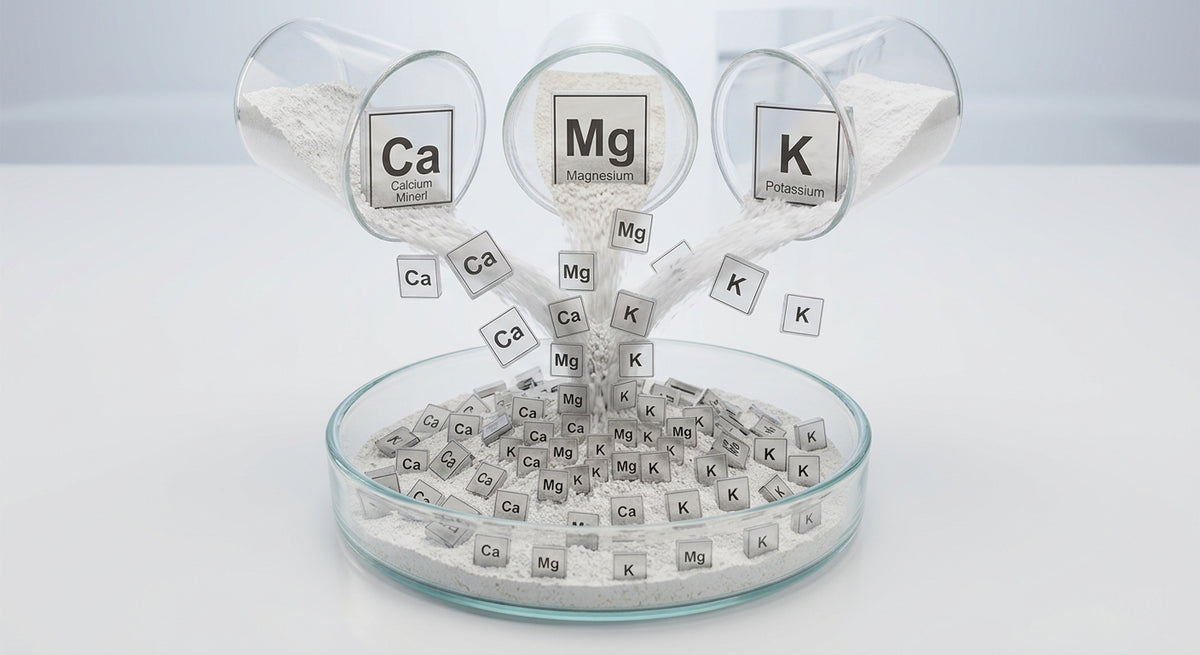
Total items
Product subtotal