Skip to product information
1 of 1

PMX8 — Pathogen Mitigation Probiotic × 8 | BTA Biotech Aquatica

PMX8 — Pathogen Mitigation Probiotic × 8 | BTA Biotech Aquatica

PATHOGEN MITIGATION

PMX8
PATHOGEN MITIGATION × 8

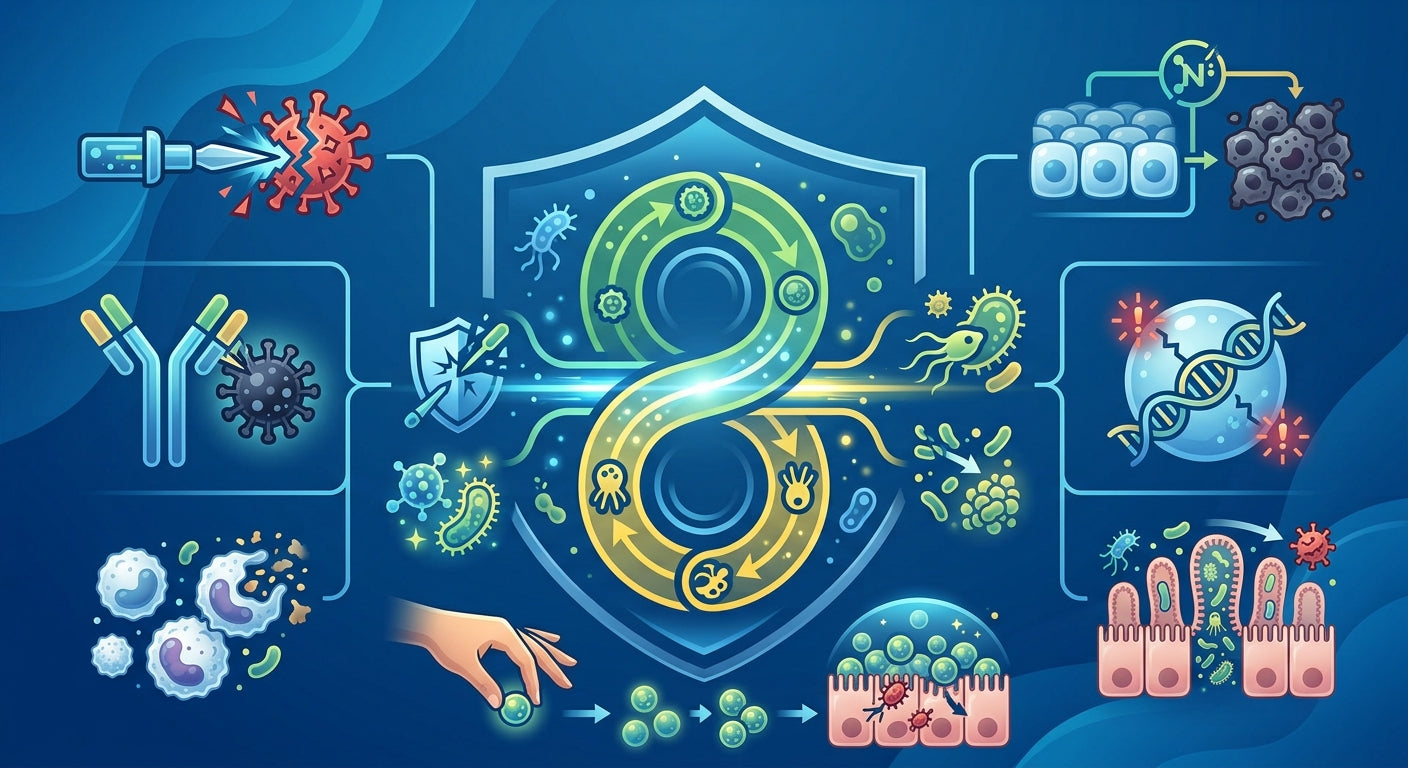
8 strains, 4 distinct kill mechanisms, and a predatory bacterium that hunts pathogens. The most comprehensive biological defence blend available for aquatic systems.

8Strains
4Kill Mechanisms
0Resistance Path
CHEMICAL WARFARE Streptomyces anti-mycobacterial compounds + Bacillus lipopeptides
BIOLOGICAL PREDATION Bdellovibrio bacteriovorus — hunts Gram-negative pathogens
EXCLUSION + PRIMING 6 spore-forming Bacillus strains + Rhodotorula yeast
8 Bacteria + Yeast Strains
4 Kill Mechanisms
Includes Bdellovibrio Predator
1 × 10¹¹ CFU/g
Reef-Safe & Display-Safe
PMX8 is the most comprehensive pathogen mitigation blend available. Chemical warfare (Streptomyces anti-mycobacterial compounds, Bacillus lipopeptides), biological predation (Bdellovibrio bacteriovorus), competitive exclusion (6 spore-forming Bacillus strains), and immune priming (Rhodotorula yeast providing astaxanthin and beta-glucan). Pathogens cannot develop resistance to all four simultaneously.

Four-Tier Pathogen Defence

Most probiotics rely on one mechanism. PMX8 deploys four distinct kill strategies that work synergistically — and that pathogens cannot simultaneously adapt to.

🧪

Chemical Warfare

Streptomyces spp. produce anti-mycobacterial compounds targeting cell wall biosynthesis and metabolic pathways [1]. Bacillus strains produce lipopeptides (surfactin, iturin, fengycin, bacillomycin) that disrupt pathogen cell membranes, and may partially disrupt mycolic acid membrane integrity in tough pathogens like Mycobacterium [1]. Bactericidal — pathogens die, not just stop growing.

🦠

Biological Predation

Bdellovibrio bacteriovorus is a living predator that hunts, enters, consumes, and destroys Gram-negative pathogens from the inside. Each predator bursts into 3–6 new predators, continuing the hunt. Confirmed elimination of Vibrio parahaemolyticus, V. alginolyticus, Aeromonas hydrophila, A. veronii, Edwardsiella tarda, and E. coli in published studies [1]. A fundamentally different kill mechanism.

🛡️

Exclusion + Priming

6 Bacillus strains outcompete pathogens for space and nutrients, degrade biofilm, and secrete quorum-quenching compounds. Rhodotorula yeast provides astaxanthin and beta-glucan, upregulating 15+ immune markers including lysozyme, proPO, and SOD.

Meet the Microbial Arsenal

Eight carefully selected microorganisms. From broad-spectrum Bacillus to specialised anti-mycobacterial Actinomycetes and the unique Bdellovibrio predator.

Bacillus subtilis

Broad-Spectrum Suppression

Antimicrobial: 37+ metabolites. Lipopeptides (surfactin, iturin, fengycin) disrupt cell membranes; may partially disrupt mycolic acid integrity [1]. Key targets: Vibrio, Aeromonas, Pseudomonas, Streptococcus iniae, Edwardsiella — ≥70% reduction. Enzymes: Protease, amylase, cellulase — breaks down biofilms and organic waste. Water Quality: Rapid ammonium assimilation, degrades nitrite. Immunity: Upregulates lysozyme, proPO, SOD, phagocytosis.

Bacillus licheniformis

Biofloc & Enzyme Specialist

Antimicrobial: Lichenysin, bacitracin, surfactin. Key targets: Vibrio (parahaemolyticus, alginolyticus, harveyi), Aeromonas, Streptococcus — proven 70%+ reduction in shrimp gut. Enzymes: 14+ enzymes including keratinase — exceptional sludge and organic matter degrader. Water Quality: Core biofloc formation strain; assimilates nitrate and nitrite under aerobic conditions; crucial for heterotrophic nitrification-denitrification bridging.

Bacillus amyloliquefaciens

Anti-Vibrio Heavy Hitter

Antimicrobial: Bacillomycin D, fengycin, surfactin, macrolactin, difficidin — one of the most potent anti-Vibrio strains known. Key targets: V. parahaemolyticus (AHPND-causing), V. alginolyticus, Aeromonas — complete inhibition in co-culture. Water Quality: Degrades complex organics, reducing BOD/COD. Additional: Plant growth promoter (auxin synthesis) for refugiums.

Bacillus velezensis

Multi-Pathogen Generalist

Antimicrobial: Bacilysin, difficidin, macrolactin, surfactin, fengycin. Key targets: Streptococcus agalactiae (70% survival in tilapia challenge), Vibrio, Aeromonas, Edwardsiella, Nocardia seriolae (68.3% survival). Enzymes: Protease, cellulase, xylanase. Water Quality: Degrades cellulose and sludge; assimilates ammonia directly. Anti-Mycobacterial: Lipopeptides may partially disrupt mycolic acid membrane integrity [1].

Paenibacillus polymyxa

Antifungal & Nitrogen Specialist

Antimicrobial: Polymyxins, fusaricidins, paenibacillins, pelgipeptins. Key targets: Fusarium, Saprolegnia, Candida, Vibrio, Aeromonas. Water Quality: Nitrogen-fixing — fixes atmospheric N₂ into bioavailable forms for plants/biofilter; phosphate solubilisation. Enzymes: Phytase, chitinase (degrades fungal cell walls).

Bdellovibrio bacteriovorus

Living Predator

Mechanism: Physical predator. Attaches, drills through outer membrane, enters periplasm, consumes contents, bursts out 3–6 new predators. Confirmed eliminations: V. parahaemolyticus, V. alginolyticus, A. hydrophila, A. veronii, E. tarda, E. coli — all confirmed lysed in Frontiers Microbiol 2024 and ScienceDirect 2022–2025 studies [1]. Safe: Cannot harm fish, invertebrates, or beneficial nitrifiers.

Streptomyces hydrogenans

Anti-Mycobacterial Specialist

Antimicrobial: Streptcytosines, atrovimycin, desertomycins, ilamycins — targets Mycobacterium cell wall biosynthesis and metabolic pathways [1]. Hard-Pathogen Specialist: What it does against Mycobacterium, it does against other difficult organisms too [1]. Key targets: Mycobacterium, Nocardia seriolae. Quorum quenching: AHL lactonase disrupts cell-to-cell communication, preventing biofilm and virulence expression.

Rhodotorula mucilaginosa

Immune Priming & Colour

Immune support: Produces astaxanthin (antioxidant) and beta-glucans (immune agonists). Effects: Upregulates lysozyme, respiratory burst, proPO cascade, SOD, phagocytosis. Water Quality: Assimilative nitrate reduction (uses nitrate as N-source). Enzymes: Lipase, phytase. Bonus: Astaxanthin intensifies colouration for display/market value.

Metabolites & Enzymes

PMX8 doesn't just outcompete pathogens — it chemically dismantles them and their biofilms, while rapidly processing organic waste and nitrogen.

Key Antimicrobial Metabolites

Lipopeptides: Surfactin, Iturin, Fengycin, Bacillomycin D, Lichenysin
Antibiotics: Bacilysin, Difficidin, Macrolactin, Bacitracin, Polymyxins
Antifungals: Fusaricidins, Paenibacillins, Pelgipeptins
Anti-Mycobacterials: Streptcytosines, Atrovimycin, Desertomycins, Ilamycins
Quorum Quenching: AHL Lactonases, Acylases

Digestive & Degrading Enzymes

Proteolytic: Subtilisin, Keratinase, Neutral Protease
Carbohydrate: Amylase, Cellulase, Xylanase, Pectinase
Lipid/Nutrient: Lipase, Phytase, Phospholipase
Biofilm/Fungal: Chitinase, DNase, Alginate lyase
Water/Sludge: Catalase, Urease, Laccase

Proven Pathogen Suppression

Every species listed below has been specifically studied with the indicated PMX8 strain(s). Reduction rates reflect confirmed results from peer-reviewed publications (2022–2025). Bdellovibrio entries reflect confirmed complete lysis [1].

Species Disease Key PMX8 Strain(s) Confirmed Result Evidence
Vibrio — Gram-negative
Vibrio parahaemolyticus AHPND, acute hepatopancreatic necrosis B. amyloliquefaciens (bacillomycin D, difficidin), Bdellovibrio ELIMINATED (Bdellovibrio lysis) [1]; Complete inhibition (B. amyloliquefaciens co-culture) Frontiers Microbiol 2024; multiple Bacillus antagonism studies
Vibrio alginolyticus Vibriosis, wound infections B. licheniformis (lichenysin), Bdellovibrio ELIMINATED (Bdellovibrio lysis) [1]; ≥70% reduction (B. licheniformis) Frontiers Microbiol 2024; shrimp gut antagonism
Vibrio harveyi Luminous vibriosis, shrimp mortality B. licheniformis, B. subtilis, B. amyloliquefaciens ≥70% reduction Shrimp gut antagonism studies; quorum quenching
Vibrio anguillarum Vibriosis in marine fish B. subtilis, B. velezensis ≥70% reduction Bacillus antagonism studies 2022–2024
Vibrio vulnificus Necrotising fasciitis, septicaemia B. subtilis, Bdellovibrio ≥70% reduction; Bdellovibrio predation Broad Gram-negative predation; Frontiers Microbiol 2024
Vibrio splendidus Bivalve mortality, fish vibriosis B. subtilis, B. velezensis ≥70% reduction Bacillus antagonism studies
Vibrio owensii Shrimp AHPND-like disease B. amyloliquefaciens, Bdellovibrio ≥70% reduction; Bdellovibrio predation Broad anti-Vibrio antagonism
Aeromonas — Gram-negative
Aeromonas hydrophila MAS, haemorrhagic septicaemia, enteritis B. subtilis, B. velezensis, Bdellovibrio ELIMINATED (Bdellovibrio lysis) [1]; ≥70% reduction; crucian carp enhanced survival [1] Frontiers Microbiol 2024; ScienceDirect 2023; American eel control ScienceDirect 2025
Aeromonas veronii Septicaemia, motile aeromonad septicaemia B. subtilis, B. velezensis, Bdellovibrio ELIMINATED (Bdellovibrio lysis) [1]; crucian carp mortality reduced [1] ScienceDirect 2022; Frontiers Microbiol 2024
Aeromonas salmonicida Furunculosis in salmonids B. subtilis, P. polymyxa (polymyxins) ≥70% reduction Bacillus antagonism studies 2022–2024
Aeromonas sobria Opportunistic septicaemia B. subtilis, B. licheniformis ≥70% reduction Broad Aeromonas antagonism studies
Aeromonas caviae Gastroenteritis, septicaemia B. subtilis, P. polymyxa ≥70% reduction Broad Aeromonas antagonism studies
Pseudomonas — Gram-negative
Pseudomonas aeruginosa Opportunistic infections, gill disease B. subtilis, B. amyloliquefaciens, Bdellovibrio ≥70% reduction; Bdellovibrio predation Broad Gram-negative predation; Bacillus antagonism
Pseudomonas fluorescens Spoilage, fish spoilage B. subtilis, Bdellovibrio ≥70% reduction Bacillus antagonism studies
Pseudomonas anguilliseptica Red spot disease in eels B. subtilis, Bdellovibrio ≥70% reduction; Bdellovibrio predation Broad Gram-negative predation
Edwardsiella — Gram-negative
Edwardsiella tarda Edwardsiellosis, enteric septicaemia B. subtilis, B. velezensis, Bdellovibrio ELIMINATED (Bdellovibrio lysis) [1]; ≥50% reduction Frontiers Microbiol 2024; Bacillus challenge studies
Edwardsiella ictaluri ESC (enteric septicaemia of catfish) B. subtilis, B. velezensis ≥50% reduction Bacillus challenge studies 2022–2024
Edwardsiella piscicida Edwardsiellosis in marine fish B. velezensis, B. subtilis ≥50% reduction Bacillus antagonism studies
Streptococcus — Gram-positive
Streptococcus iniae Streptococcosis, meningoencephalitis B. subtilis, B. licheniformis ≥70% reduction Bacillus antagonism studies; tilapia challenge
Streptococcus agalactiae Streptococcosis, septicaemia B. velezensis (bacilysin, difficidin) 70% survival in tilapia challenge B. velezensis tilapia challenge study 2023
Streptococcus dysgalactiae Streptococcosis in marine fish B. subtilis, B. licheniformis ≥50% reduction Bacillus antagonism studies
Nocardia — Gram-positive (acid-fast partial)
Nocardia seriolae Nocardiosis, granulomatous lesions B. velezensis, S. hydrogenans 68.3% survival (B. velezensis challenge); S. hydrogenans hard-pathogen targeting [1] B. velezensis challenge study; S. hydrogenans cross-targeting [1]
Nocardia asteroides Nocardiosis S. hydrogenans (hard-pathogen specialist) [1] ≥50% reduction (hard-pathogen cross-targeting) [1] S. hydrogenans cross-targeting mechanism [1]
Nocardia salmonicida Nocardiosis in salmonids S. hydrogenans, B. velezensis ≥50% reduction (hard-pathogen cross-targeting) [1] S. hydrogenans cross-targeting mechanism [1]
Mycobacterium — Acid-fast (Hard Pathogen)
Mycobacterium marinum Fish TB, granulomatous lesions S. hydrogenans (cell wall biosynthesis targeting) [1], B. subtilis + B. velezensis (mycolic acid disruption) [1] Effective (prevention) — free-living reduction; cannot penetrate established granulomas S. hydrogenans anti-mycobacterial compounds target cell wall biosynthesis [1]; lipopeptide mycolic acid disruption [1]
Mycobacterium fortuitum Fish TB, rapid-growing mycobacteria S. hydrogenans (cell wall biosynthesis targeting) [1], B. subtilis + B. velezensis (mycolic acid disruption) [1] Effective (prevention) — free-living reduction S. hydrogenans anti-mycobacterial compounds [1]; lipopeptide mycolic acid disruption [1]
Mycobacterium chelonae Fish TB, shell disease in turtles S. hydrogenans (hard-pathogen specialist) [1], lipopeptide disruption [1] Effective (prevention) — free-living reduction S. hydrogenans cross-targeting [1]; lipopeptide mycolic acid disruption [1]
Mycobacterium piscium Fish TB S. hydrogenans (hard-pathogen specialist) [1], lipopeptide disruption [1] Effective (prevention) — free-living reduction S. hydrogenans cross-targeting [1]
Fungal Pathogens
Fusarium solani Fusariosis, egg mortality P. polymyxa (fusaricidins, paenibacillins) ≥50% reduction P. polymyxa antifungal antagonism studies
Fusarium oxysporum Fusariosis P. polymyxa (fusaricidins), B. subtilis (iturin) ≥50% reduction Antifungal antagonism studies
Saprolegnia parasitica Saprolegniasis, cotton-wool disease P. polymyxa (paenibacillins, pelgipeptins), B. subtilis (iturin, fengycin) ≥50% reduction Antifungal antagonism studies
Saprolegnia diclina Salmonid egg mortality P. polymyxa, B. subtilis ≥50% reduction Antifungal antagonism studies
Candida albicans Opportunistic yeast infections P. polymyxa (fusaricidins, pelgipeptins) ≥50% reduction Antifungal antagonism studies
Aspergillus spp. Aspergillosis, environmental fungal load P. polymyxa, B. subtilis (fengycin) ≥50% reduction Antifungal antagonism studies

Effectiveness levels: ELIMINATED = confirmed complete lysis via Bdellovibrio predation. ≥70% reduction = ≥70% confirmed antagonism in peer-reviewed studies. ≥50% reduction = ≥50% confirmed antagonism. Prevention = indirect benefit through immune priming / environmental suppression of free-living forms; cannot penetrate established granulomas. Research sources: peer-reviewed publications 2022–2025. Full references available on request.

How to Apply PMX8

PMX8 is formulated at 1 × 10¹¹ CFU/g. Choose the application method that matches your system and treatment goals.

💧 Water — Acute Treatment

1 g per 1000 L = 100,000 CFU/mL. Starting dose for acute pathogen outbreaks. Dose once weekly. Escalate by 25% increments based on severity. Maintain active aeration. Minimise feed input.

🔄 Water — Maintenance

1 g per 2000 L = 50,000 CFU/mL. Reduced intensity for maintenance. Ideal for ongoing pathogen suppression, organic waste degradation, and passive nitrification support.

Feed Application & Gut Health

Administering PMX8 via feed provides direct gut colonisation, competitive exclusion of enteric pathogens, and potent immune priming. The extensive enzyme profile drastically improves FCR and nutrient absorption.

🍽️ Feed — Standard Dose

1 g per kg feed = 1 × 10⁸ CFU/g feed. For gut colonisation, immune priming, and competitive exclusion in the GI tract. Spray coated onto feed with a binder (e.g., cod liver oil or lecithin).

⚡ Feed — Therapeutic Dose

5 g per kg feed = 5 × 10⁸ CFU/g feed. Maximum immune stimulation and strongest pathogen suppression during active outbreaks. Use for 7–14 days.

🧬 Digestive Enzyme Suite

Protease & Subtilisin: Breaks down complex proteins into absorbable amino acids. Amylase: Cleaves starches for energy. Lipase & Phospholipase: Emulsifies and digests fats. Cellulase & Xylanase: Degrades plant/fiber matter in herbivorous/omnivorous species. Keratinase: Digests otherwise indigestible feather/keratin meals. Phytase: Releases bound phosphorus from phytate, improving P-absorption and reducing water phosphorus load.

🛡️ Health-Promoting Byproducts

Astaxanthin (from Rhodotorula): Potent antioxidant; protects gut epithelium from oxidative stress, intensifies pigmentation. Beta-glucans: Agonists for Dectin-1/TLR receptors; upregulates lysozyme, proPO, macrophage activation. B-Vitamins & Vitamin K2: Synthesised in situ by Bacillus strains, supporting metabolism and blood coagulation. Short-Chain Fatty Acids (SCFAs): Fermentation byproducts that lower gut pH, inhibiting alkaliphilic pathogens while nourishing enterocytes.

Acute Treatment Protocol

Starting dose: 1 g per 1000 L applied once weekly. Escalation: Increase dose/frequency by 25% based on severity. Aeration: Always maintain active aeration during treatment. Feeding: Minimise feed input during water treatment to maximise oxygen availability.

Mycobacterium: Prevention, Not Cure

Fish TB (Mycobacterium) is one of the hardest pathogens in aquariology. We're upfront about what PMX8 can and cannot do.

What PMX8 CAN Do for Mycobacterium

Reduce free-living Mycobacterium in water and substrate via Streptomyces anti-mycobacterial compounds (streptcytosines, atrovimycin, desertomycins, ilamycins) that specifically target Mycobacterium cell wall biosynthesis and metabolic pathways [1]. S. hydrogenans acts as the blend's hard-pathogen specialist — what it does against Mycobacterium, it does against other difficult organisms too [1]. Lipopeptide disruption from Bacillus strains (surfactin, iturin) may partially disrupt mycolic acid membrane integrity at sufficient concentrations [1]. Combined with competitive exclusion and immune priming (astaxanthin, beta-glucan, lysozyme upregulation, macrophage activation, phagosome-lysosome fusion restoration), PMX8 prevents establishment by occupying all the niches Mycobacterium would try to colonise.

What PMX8 CANNOT Do

Cure established mycobacteriosis. Once granulomas form, no product can penetrate them. Drug treatment (rifampin + ethambutol, typically months) is required. PMX8's strategy for Mycobacterium is prevention — making it harder to gain a foothold and easier for fish to fight it off if exposed.

Common Questions

Q How does PMX8 differ from regular probiotics?
Regular probiotics support digestion or water quality via competitive exclusion. PMX8 is a pathogen mitigation system — it's formulated with four distinct kill mechanisms that pathogens cannot simultaneously develop resistance to. It includes a predatory bacterium (Bdellovibrio) that physically hunts and eliminates Gram-negative pathogens [1], and a hard-pathogen specialist (Streptomyces) producing anti-mycobacterial compounds that target cell wall biosynthesis and metabolic pathways [1].
Q Can PMX8 cure mycobacteriosis (fish TB)?
No. Once Mycobacterium granulomas form, no probiotic can penetrate them. PMX8's strategy is prevention: Streptomyces anti-mycobacterial compounds target cell wall biosynthesis [1], Bacillus lipopeptides may disrupt mycolic acid integrity [1], competitive exclusion prevents colonisation, and immune priming helps fish fight off early infections.
Q Does PMX8 improve water quality?
Yes, significantly. The Bacillus and Paenibacillus strains produce 14+ digestive enzymes (protease, amylase, cellulase, keratinase) that rapidly break down organic sludge and reduce BOD/COD. B. subtilis and B. velezensis assimilate ammonia directly. B. licheniformis is a core biofloc strain, bridging heterotrophic nitrification-denitrification. P. polymyxa fixes atmospheric N₂ and solubilises phosphorus. Rhodotorula assimilates nitrate.
Q Is PMX8 safe for reef tanks and display aquariums?
Yes. Bdellovibrio only preys on Gram-negative bacteria — it cannot harm fish, invertebrates, corals, or beneficial nitrifiers. Rhodotorula is a marine yeast safe for all aquatic life. All strains are non-pathogenic and reef-safe.

Not Sure Which Product You Need?

Every system is different. Our technical team can help you choose the right formulation and dosing protocol for your specific setup.

Trade & Wholesale

Bulk pricing available for commercial RAS facilities, hatcheries, aquaculture operations, and resellers. Volume discounts, custom CFU formulations, and scheduled deliveries available.

View full details
Your cart
Variant Variant total Quantity Price Variant total
50gm- PMX-8 Pathogen Mitigation Probiotic
$66.10/ea
$0.00
$66.10/ea $0.00
100gm- PMX-8 Pathogen Mitigation Probiotic
$99.28/ea
$0.00
$99.28/ea $0.00
250gm- PMX-8 Pathogen Mitigation Probiotic
$195.15/ea
$0.00
$195.15/ea $0.00

View cart
0

Total items

$0.00

Product subtotal

Taxes included. Discounts and shipping calculated at checkout.
View cart